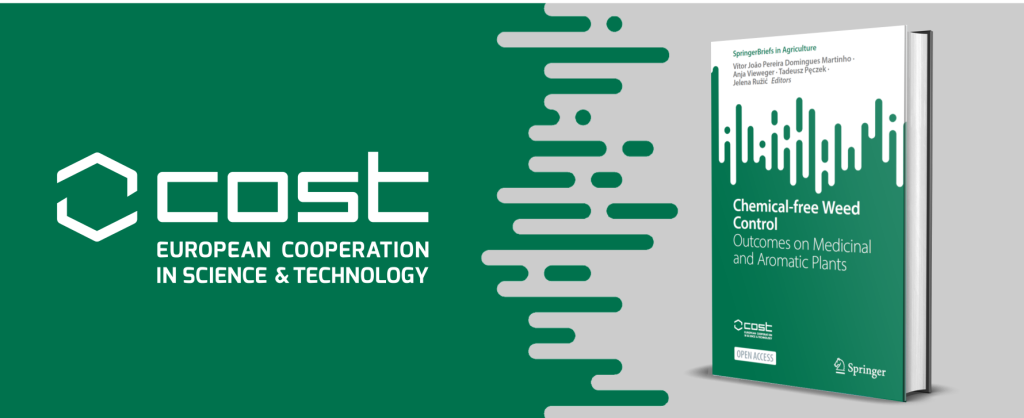
PRO CIVIS experts are publishing in Springer
“Chemical-free Weed Control. Outcomes on Medicinal and Aromatic Plants” is the new publication in SpringerBriefs in Agriculture series delivered jointly by PRO CIVIS experts and scientists from Warsaw University of Life Sciences (SGGW), Bulgarian Academy of Sciences, Polytechnic University of Viseu (Portugal) and Antalya Metropolitan Municipality (Türkiye).
The book presents the results of research carried out by interdisciplinary teams on the
broadly understood subject of non-chemical weed management in medicinal and aromatic plants. The book aims to provide insights into the current political and legislative framework within the European Union and in selected Member States – insights, which may act as drivers or barriers to the implementation of non-chemical management practices and technologies in the production of aromatic and medicinal plants. The European Union has
a set of strategies for climate and biodiversity, as well as a range of instruments within the Common Agricultural Policy, which are worth analysing in terms of their impact and relationship with the aromatic and medicinal plant sector.
Furthermore, it is important to understand the decision-making process at farm level, and this is also addressed in the publication. Indeed, there are a number of factors relating to farmers’ perceptions, technological availability and needs, labour availability, consumer pressures, market functioning and the legislative framework that influence farmers’ decisions.
Finally, the book addresses the involvement of stakeholders in the aromatic and medicinal plant sector. This analysis starts with the characteristics of value chains for the sector. All the important value chain components are explored, as well as actions directly supporting value chains. The publication moves then to address networks and initiatives focused on non—chemical weed management in medicinal and aromatic plants in the EU and in the EU associated countries, outlining the subject of policy advocacy of the networks. As the stakeholders in the sector are diverse, including farmers, collectors, processors, traders, retailers, policy makers, financial institutions, researchers, and consumers – the analysis of the intersections and stakeholders’ expectations along the value chains is delivered. The next subject of importance are the tools and methods with the potential to improve partners engagement in the networks. The general observations conclude with the results of the mapping of selected existing medicinal and aromatic plants’ networks and their characteristics in terms of such features as co-operation, needs, limitations and expectations. The medicinal and aromatic plants systems, networks and value chains in Poland, Türkyie and Bulgaria are presented in more detail.
The book has been researched, written and published as part of the COST CA23123 project “Non – chemical weed management in medicinal and aromatic plants (MAPs)” (weedingMAPs).