
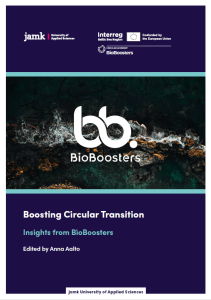
Boosting Circular Transition
“Boosting Circular Transition”: a Must – Read
for all circular bioeconomy Stakeholders, innovation Facilitators and regional Policy-Makers
In the last three years innovations hubs representing 9 European regions (incl. Polish Świętokrzyski region represented by the PRO CIVIS Foundation) executed jointly an INTERREG Baltic Sea Region financed project “BioBoosters – Boosting the Circular Transition”. The main purpose was a pilot of hackathon model as an open innovation tool for the substantive areas of circular and bioeconomy.
The numbers of the Project are very impressive:
- 18 business-driven hackathons validating over 120 solution ideas
- 246 teams from more than 20 countries applying to participate
- 23 RDI and business collaborations launched, including 13 international partnerships
- over 500 experts involved, and more than 1,800 professionals connected through
the BioBoosters community
All this means that a lot of essential materials, valuable observations and future-oriented conclusions have been summoned. They all are being presented in the recently published book “Boosting Circular Transition”, prepared and written by the experts from all the 9 Project partners – innovation hubs, acting on a daily basis as connectors and innovation intermediaries or brokers in their regional innovation systems. PRO CIVIS experts contributed to the publication by co-writing 8 out of 14 articles.
This is very exciting and enriching publication, which shall be of interest to all the stakeholders of the circular and bioeconomy areas, as well entities striving for more innovative methods and solutions, both at the business and territorial levels.
As Anna Aalto – the BioBoosters Project Leader emphasizes:
“The publication presents the collectively accumulated know-how on open innovation, circular bioeconomy paradigm and inter-regional smart specializations. Moreover the authors explore the relevance, efficiency, impact and sustainability of the BioBoosters hackathon model and the inter-regional cooperation the model has sparked.”
“Boosting Circular Transition” is available at this link: https://interreg-baltic.eu/project-posts/bioboosters/new-bioboosters-publication-highlights-three-years-of-accelerating-circular-innovation-across-the-baltic-sea-region/
First and foremost the publication describes the value of the BioBoosters hackathon as an open innovation process. The BioBoosters innovation method emphasizes networking, visibility, and learning value through cross-sectoral and interregional expertise exchange and interaction between industry and academic experts. From this part of the publication the reader will learn what are the main phases of the BioBoosters hackathon process and who are the main players, i.e. the challenge provider, the solution provider teams, the mentors and the organizer. Important practical tips are presented on the formulation of the challenge, the necessary components of the hackathon invitation, the most effective scouting strategies for potential solution providers and the supportive involvement of the mentors. The detail presentation of the actual Hackathon Days, being the final act to the process, has also been outlined. Co-designing a new product or service, establishing a proof-of-concept, or testing and demonstrating new technology, are displayed and described as the main benefits and results of the BioBoosters hackathons.
But the publication does not limit itself to the operational features of this particular open innovation method. As the title indicates the substance of the book is “the circular transition”, meaning the exploration of the challenges tackled with BioBoosters hackathons in the framework of circular bioeconomy transition and sustainable bioeconomy development. This takes place by the in-depth verification of the extent to which these hackathons have appropriately responded to the macro-regional and EU strategies on circular bioeconomy transition – in more general terms, and to the expectations of the companies searching for innovations – in the individual cases. It has been proved that the challenges put forward in the 18 BioBoosters hackathons were far reaching and were covering most of the key and current topics of the global, European and Baltic Sea Region circular bioeconomy agenda, i.e. making sustainable products, ensuring less waste and reinforcing sustainability of agriculture and forestry. At the same time the products, services, methods and models proposed as innovative solutions to the posed circular bioeconomy challenges introduced new concepts or creatively used existing concepts and available technologies contributing to the better understanding and wider dissemination of the circular bioeconomy paradigm.
The third important theme of the publication is the impact of the BioBoosters hackathons on the regional development. The authors aim to respond to the general question “Why the regional authorities shall be interested in attracting the BioBoosters hackathons in order to strengthen the impact the given smart specializations exercise on the development of the region?”. Smart specialization strategies are important tool in the EU scale for driving the sustainable and smart economic transitions of the regions, mainly by developing greener and more circular and digital businesses. As there is always an actual demand for new and innovative projects contributing, maybe even in an unorthodox way, to the reinforcement of the given smart specialization and its actual influence on the regional development – these are the hot-spots where the hackathon model may or even shall be employed. The BioBoosters hackathons have obviously been supportive for the smart specialization strategies of the connected 9 Project’s regions, e.g. circular solutions for biological and technological materials, forest-based bioeconomy, agriculture & food with support for organic food production, sustainable energy systems and recycling and reusability of biological and industrial materials.
The three above presented substantive areas of the publication are by far not exhausting the topic of boosting the circular transition by employing the hackathon process.
All the readers interested in the operational features of the BioBoosters hackathon and the impacts of these open innovation ventures on the entities involved (mainly organizers, challenge and solution providers) shall get acquainted with the book’s articles dealing with the following practical questions:
- how to correctly structure and deliver on the issues of value propositions for the main stakeholders involved, i.e. challenge providers, solution providers and mentors?
- how impactful the hackathon process could become in terms of launching innovation partnerships and what are the factors determining and supporting the launch of the successful co-operations after hackathon?
- what role may the hackathon play in improving the offers of the regional innovation hubs, acting as the hackathons’ organizers?
- to what extent are the hackathons able to strengthen the positions of the organizers in the regional and international innovation landscapes?
At the same time the publication still offers enlightening insights on the more horizontal topics such as: 1) the execution of the objectives of the European Union and Baltic Sea Region strategical documents relating to circular economy transition and sustainable bioeconomy development in the regions, 2) internationalization of the innovation community, 3) inter-regional co-operation capacity.
As Małgorzata Olesiak, Expert at PRO CIVIS and co-writer of the publication, summed – up: “The BioBoosters model has demonstrated its ability to promote sustained collaboration, strengthen international networks, and empower participants to co-create innovative solutions for a more sustainable bioeconomy. It was very exciting and enriching to analyse the 18 hackathons from the perspective of the 4 main evaluation criteria, i.e. relevance, effectiveness, sustainability and impact. It must be emphasized that the hackathons delivered strongly on the very ambitious value propositions for Challenge and Solution Providers, as well as for Mentors.”
About BioBoosters
BioBoosters is an EU-funded initiative under the INTERREG Baltic Sea Region Programme, connecting organizations from seven countries to drive the green transition in the bioeconomy. Using its hackathon model and accelerator, BioBoosters unites innovators, researchers, and industry partners to co-create practical, scalable solutions for sustainable business models across the region.